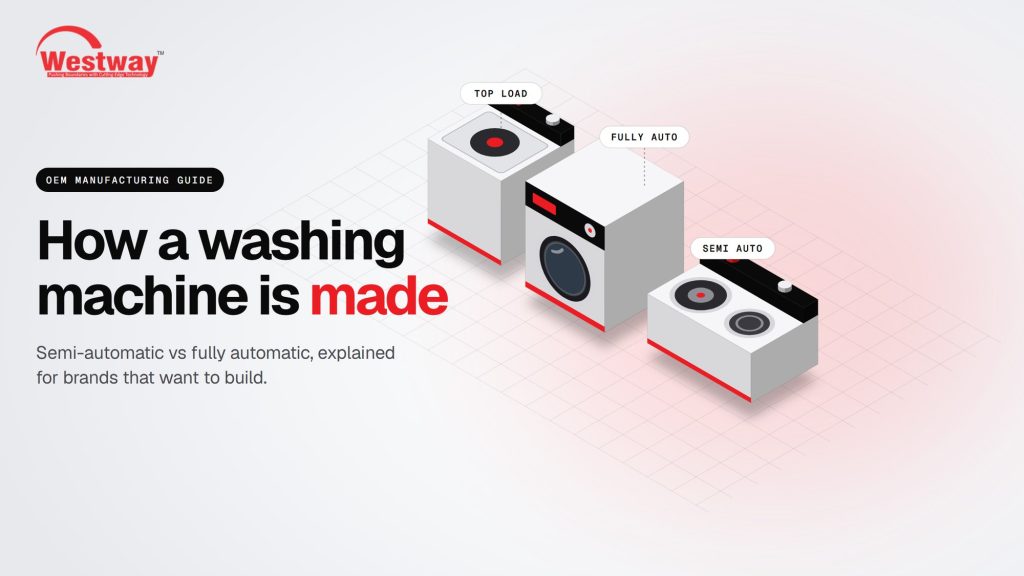
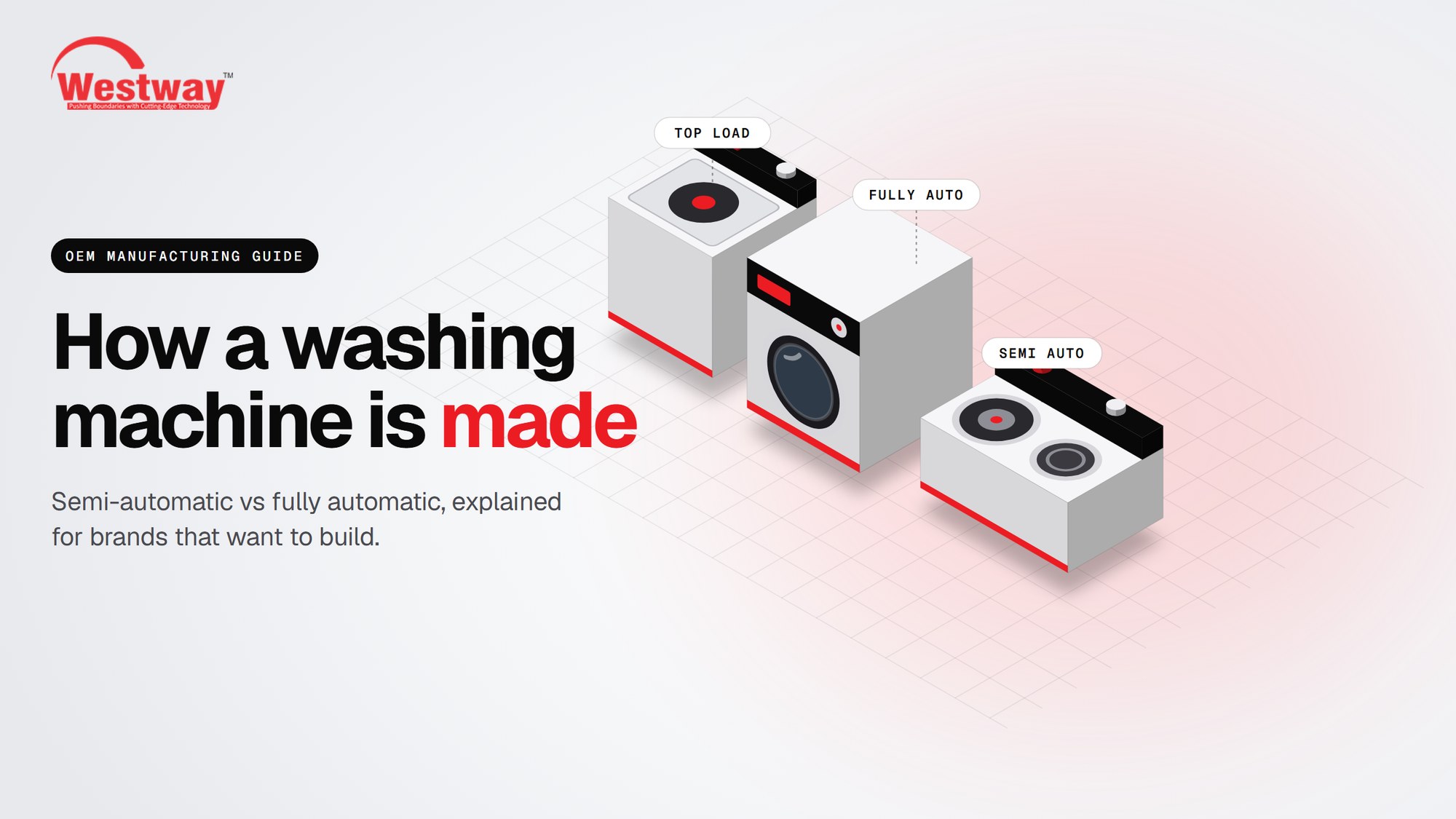
If you plan to launch your own brand of washing machines, one of the first questions you will face is simple: semi-automatic or fully automatic? The answer changes the parts list, the factory line, the testing needed and, in the end, the price your customer pays.
This guide explains the washing machine manufacturing process from raw sheet metal to the packed carton, and then compares semi-automatic and fully automatic machines from an OEM buyer’s point of view.
What a washing machine is made of
Whatever the format, every washing machine is built from the same few systems:
- Cabinet and body: pressed and painted steel or moulded plastic that holds everything.
- Tub and drum: the outer tub holds water; the inner drum (often stainless steel) holds clothes and spins.
- Motor and drive: the motor, belt, clutch or gearbox that turns the drum or pulsator.
- Controller: a mechanical timer in simple machines, or a PCB (printed circuit board) with sensors in automatic ones.
- Water system: inlet valve, drain pump or drain valve, hoses and filters.
- Suspension and balance: springs, dampers and balance rings that keep a spinning load steady.
How a washing machine is manufactured: step by step
A factory follows broadly the same order for every model. The details differ by format, which we cover below.
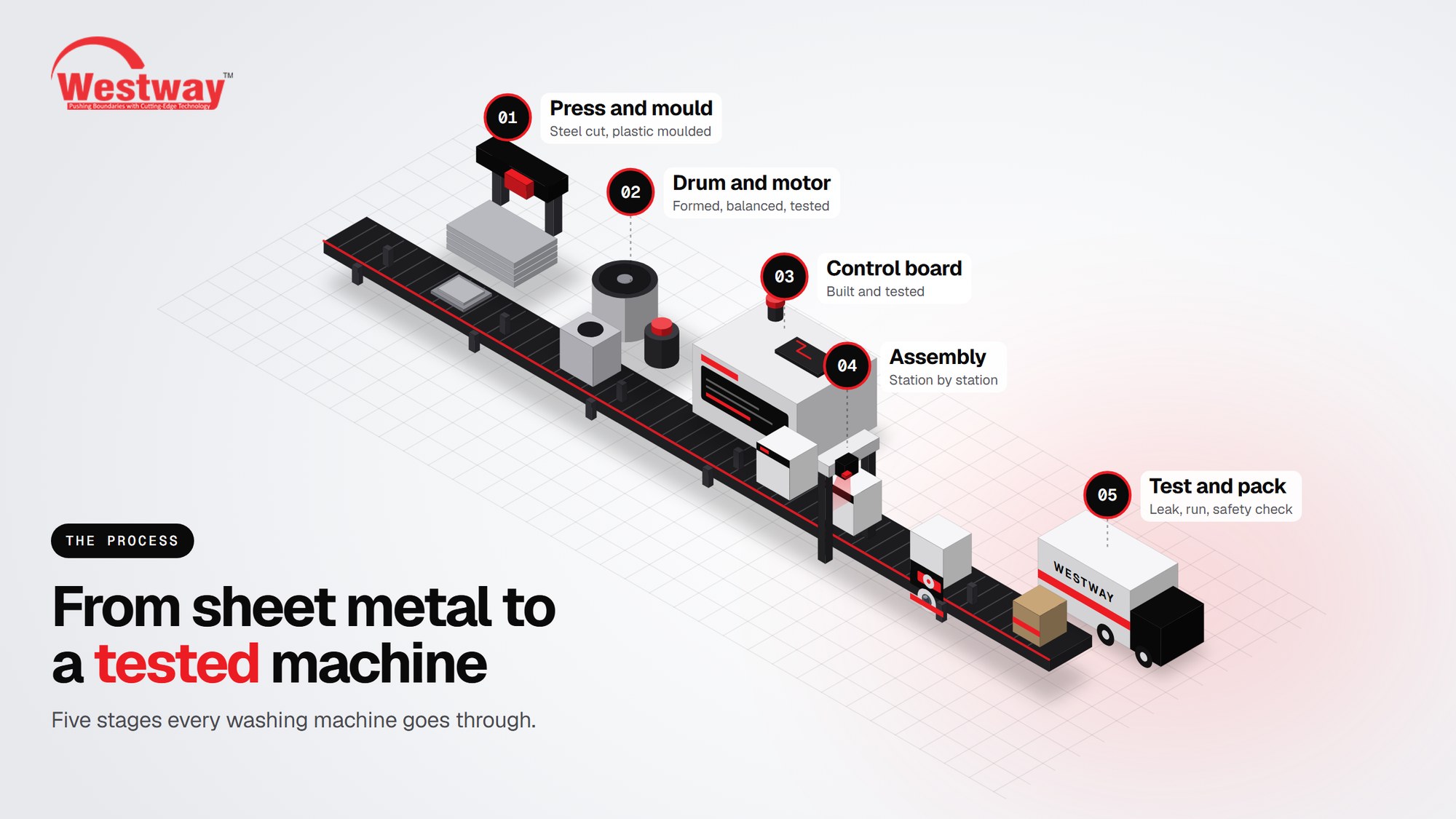
- Design and tooling. The product is specified, a 3D structure is designed, and moulds and press tools are made. This is the longest lead-time item, so it is fixed early.
- Sheet metal and plastic parts. Steel is cut, pressed, bent and painted for the cabinet. Plastic parts such as the lid, tub and control panel are injection moulded.
- Tub and drum forming. The drum is formed and perforated, then fitted to the tub and checked for balance.
- Motor and drive assembly. The motor, belt and clutch (or direct drive) are assembled and tested before they go to the line.
- Control board production. In automatic machines the PCB is built on an SMT line, then tested with its sensors and display.
- Sub-assembly. Wiring harnesses, valves, pumps and the control panel are prepared as ready-to-fit units.
- Final assembly line. The body, tub, drum, motor, harness and controller are brought together station by station.
- Testing and packing. Each machine is run, checked for leaks and electrical safety, then packed with its accessories.
Semi-automatic washing machines
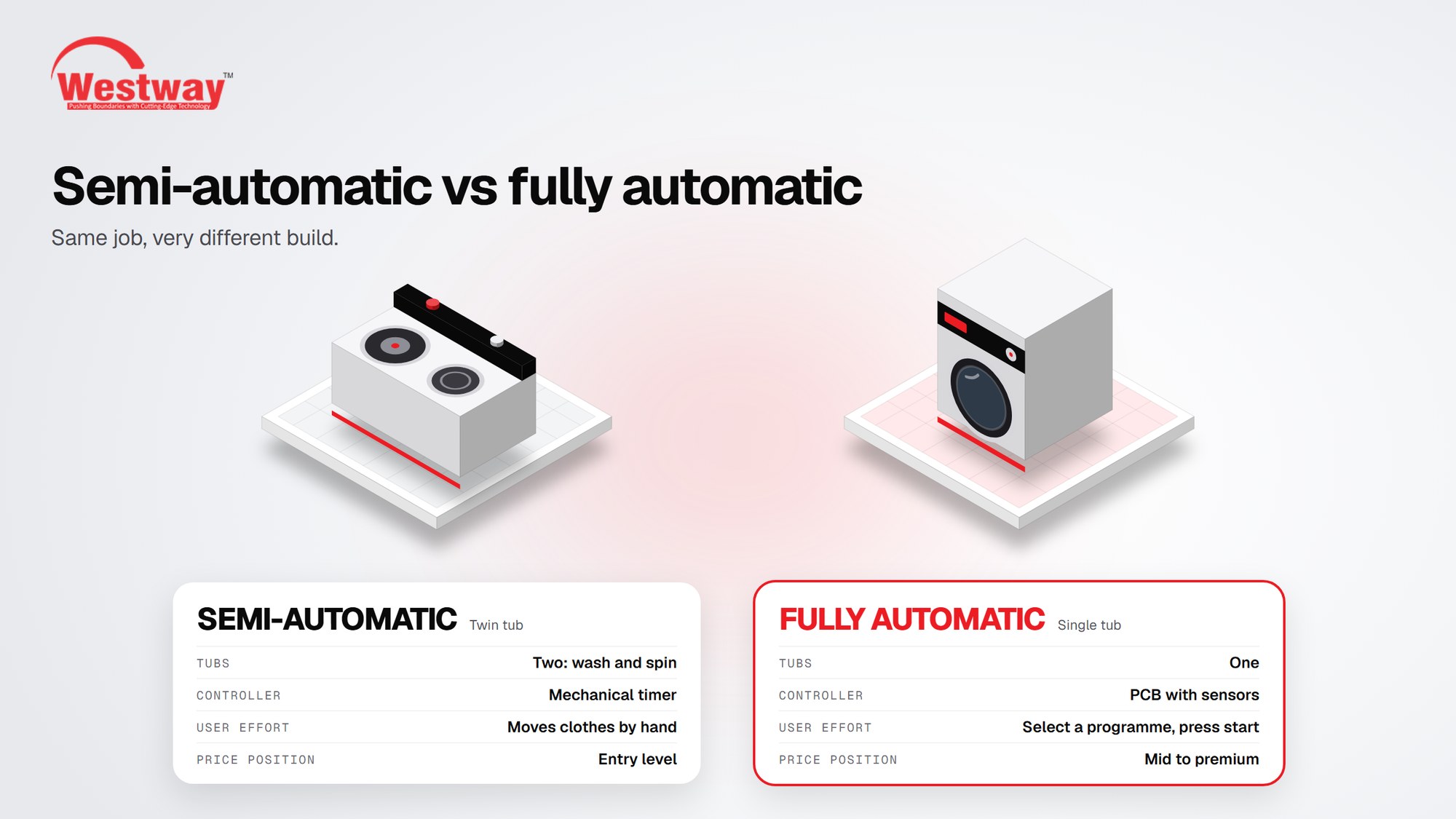
A semi-automatic machine has two tubs side by side: one for washing and one for spinning (drying). The user fills water, sets a mechanical timer, and moves the clothes by hand from the wash tub to the spin tub.
- Two small motors, one for the wash pulsator and one for the spinner.
- A timer knob instead of a PCB, so there are fewer electronic parts.
- Manual water filling and manual transfer of clothes.
- A simpler line with fewer assembly steps and less testing equipment.
Because the build is simpler, semi-automatic machines are normally the lower-cost option. They suit buyers who want an entry-level price point.
Fully automatic washing machines
A fully automatic machine has a single tub and runs the whole cycle on its own: fill, wash, rinse, spin and drain. A controller board reads a water-level sensor and runs a programme the user selects. There are two common formats:
- Top loader: clothes go in from the top, and a pulsator or agitator moves the load. Usually lower in price and quick to load.
- Front loader: clothes go in through a door at the front and a horizontal drum tumbles them. It uses a door lock, a heavier suspension and a more precise balance.
Both formats need a PCB, sensors, valves, a drain pump and more testing, so the factory process has more steps than for a semi-automatic machine.
Semi-automatic vs fully automatic: side-by-side
| Point | Semi-automatic | Fully automatic |
|---|---|---|
| Tubs | Two (wash and spin) | One |
| Controller | Mechanical timer | PCB with sensors |
| User effort | Fill water and move clothes by hand | Select a programme and press start |
| Motors | Two | One main motor (plus pump) |
| Factory complexity | Lower | Higher (SMT, more testing) |
| Typical price position | Entry level | Mid to premium |
How washing machines are tested before they ship
Quality checks run at several points on the line, not only at the end. Typical checks include:
- Leak test: the tub and hoses are filled and watched for seepage.
- Run test: a full cycle with spin to check noise, vibration and balance.
- Electrical safety test: insulation and earth continuity checks on every unit.
- Function test: every button, programme, sensor and protection is exercised on automatic models.
- Final inspection: appearance, accessories and packing.
Which format should an OEM brand choose?
There is no single right answer. These questions usually decide it:
- Who is your customer? Entry-level households often choose semi-automatic; urban buyers often prefer fully automatic.
- What is your target price? Fewer electronics means a lower build cost.
- What features do you want? Programmes, sensors and protections need a PCB, which means a fully automatic machine.
- What volume do you plan? Tooling is a fixed cost, so volume per model matters.
Washing machine manufacturing at Westway Electronics
Westway Electronics (India) Ltd, based in Noida, has been building washing machines since 2019 and supports brands under OEM and ODM models. Our range covers top loaders, front loaders and dryers from 2.8 kg to 18 kg, with features such as overheating protection, overflow protection, automatic power-off on standby, a stainless steel drum and anti-winding to reduce wear on clothes.
We support your product from market research, design and 3D structure through prototype, tooling, sample evaluation and pilot run to mass production. See our washing machine manufacturing page, our wider manufacturing services and our facility. Buyers comparing partners may also like our guide to washing machine manufacturers in India.
Frequently asked questions
What are the main steps in washing machine manufacturing?
Design and tooling, sheet metal and plastic parts, tub and drum forming, motor assembly, control board production, sub-assembly, final assembly, and testing and packing.
What is the difference between a semi-automatic and a fully automatic washing machine?
A semi-automatic machine has separate wash and spin tubs and needs the user to move clothes by hand. A fully automatic machine has one tub and runs the full cycle on its own through a control board.
Is a top loader or a front loader easier to manufacture?
A top loader is generally simpler: no door lock or door seal, and a lighter suspension. A front loader needs a precise drum balance and a door system, so it takes more tooling and testing.
Can an OEM brand customise a washing machine?
Yes. Under OEM and ODM models, capacity, colours, control panel, programmes and branding can be tailored to your specification.
Plan your washing machine line with Westway
Tell us your target market, capacity and price point, and we will help you choose the right format. Visit our contact page, call +91 98702 78855 or +91 96673 00441, or email info@westwayelectronics.com.